
BEYOND THE AUTOMATION FALLACY: BALANCING AUTOMATION WITH HUMAN EXPERTISE
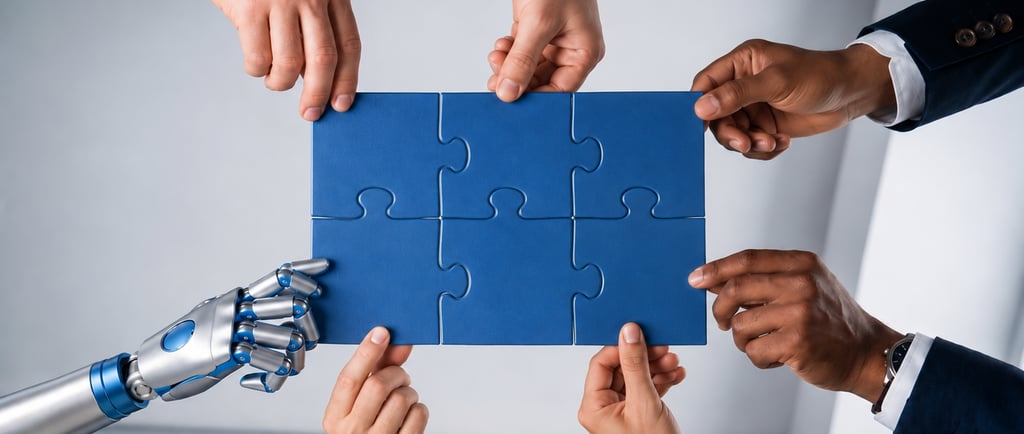
The future of work isn't about "humans versus machines"; it is about building stronger collaboration between human capability and intelligent systems. While AI delivers unmatched scalability, it cannot replicate emotional intelligence, critical thinking, or ethical decision-making.
5/26/20264 min read
THE GROWTH AND EVOLUTION OF ARTIFICIAL INTELLIGENCE
The growth of Artificial Intelligence (AI) over the past decade has created a major change in the global economy and technology landscape. Looking back, this growth has been extremely rapid, Current estimates suggest that the global AI market valuations projected to surge from approximately $400–$500 billion today to over $3.4 trillion by the early 2030s. This rapid expansion is fuelled by record-high private investments, significant performance improvements in generative AI and deep learning, and widespread enterprise adoption across critical industries like healthcare, finance, and manufacturing.
THE AUTOMATION FALLACY IN MODERN ENTERPRISES
As AI becomes more common in businesses, its use across important sectors shows both major successes and serious challenges. Companies are increasingly using Generative AI in their daily operations to improve efficiency. In the finance sector, AI is being used for financial planning, fraud detection, and invoice processing; in some cases, Firms integrating these AI-powered tools report up to an 81% reduction in processing costs and a 73% acceleration in overall processing times. Furthermore, this automation decreases human errors by 40%, enabling companies to scale operations effectively without increasing their headcount.
However, an important issue must be recognized: many companies are adopting AI in the wrong way. In an effort to cut costs quickly, several organizations fall into the “automation fallacy,” where AI is used mainly to replace human employees in the name of efficiency. A well-known example of this failure involved a large European financial technology company that replaced 700 customer service employees with an AI system. The company underestimated the importance of human understanding, problem-solving ability, and empathy, which led to a decline in customer experience and eventually forced the company to change its approach and hire human staff again. These failures usually do not happen because the technology is weak; they happen because of poor planning and wrong business strategies.
COLLABORATION BETWEEN AI AND THE HUMAN WORKFORCE
To fully benefit from artificial intelligence, companies must shift away from a "humans versus machines" mindset and adopt a collaborative approach where humans and machines work together. The foundation of this system relies on a detailed integration strategy and a smart division of labor based on the unique strengths of both parties.
To seamlessly implement AI into their firms, organizations should focus on the following steps:
Review and Update Workflows: Organizations need to evaluate their current operational workflows and update outdated job structures to successfully combine existing business frameworks with new AI tools.
Delegate Routine Tasks to AI: To improve productivity, companies should assign AI systems to handle large volumes of data, perform repetitive tasks, and automate routine processes.
Prioritize Human Expertise: Ensure that human involvement remains central in areas that require critical thinking, personal judgment, and complex decision-making.
THE BALANCE BETWEEN HUMAN JUDGMENT AND MACHINE INTELLIGENCE
Understanding how to manage this collaboration effectively requires recognizing the different strengths of human intelligence and AI systems. In this way, the weaknesses of one can be balanced by the strengths of the other, creating a more efficient and effective working system.
Human Strengths
Human thinking, shaped by evolution and emotion, provides irreplaceable corporate value. While AI excels at analysing data, humans are far better at navigating uncertainty, novel challenges, and interpersonal relationships. Employees’ ability to question assumptions, empathize with stakeholders, and adapt during crises creates a level of organizational resilience that technology lacks. These essential human strengths fall into four main areas:
Complex Problem Solving & Creativity: Humans can think creatively, explore new ideas, and solve open-ended problems, helping organizations drive innovation and adapt to changing situations.
Emotional Intelligence & Empathy: People can build trust, understand emotions and motivations, and manage interpersonal conflicts, which are essential for teamwork and strong client relationships.
Ethical Judgment & Nuance: Humans apply moral reasoning and contextual understanding when making decisions, ensuring business actions remain ethical and socially responsible.
Adaptability & Resilient Leadership: In uncertain situations, human determination, flexibility, and leadership help organizations overcome challenges and stay focused on shared goals.
AI Strengths
Conversely, AI transcends human cognitive limits, operating free from fatigue or emotional distraction. Powered by advanced computing and mathematics, it processes massive amounts of data at an unmatched scale. When effectively managed, AI significantly enhances organizational efficiency and decision-making. Its core business strengths fall into four key areas:
Speed & Absolute Scalability: AI can process large numbers of tasks at the same time, support thousands of users, and operate continuously without fatigue or loss of efficiency.
Pattern Recognition & Predictive Analytics: AI can analyse massive amounts of data to identify trends and hidden connections, helping organizations improve forecasting, risk analysis, and fraud detection.
Consistency in Repetitive Workflows: In routine and rule-based tasks, AI performs with the same level of accuracy every time, reducing human errors and improving operational efficiency.
Content Generation & Data Synthesis: Advanced AI systems can quickly organize and summarize large amounts of information, assist in drafting content or code, and personalize communication on a large scale.
Evidence suggests the ultimate competitive advantage lies in seamless human-AI collaboration. Combining AI's processing scale with human judgment and empathy yields powerful results. Strategic AI integration enhances human productivity, driving business growth and employee satisfaction while avoiding the pitfalls of replacement-driven resistance.
To realize this potential, HR must lead the transition by redesigning roles, fostering continuous learning, and building AI literacy. As AI automates repetitive tasks, employees are freed to focus on strategy, innovation, and relationship-building. Ultimately, treating AI as a partner rather than a replacement ensures long-term, sustainable success.